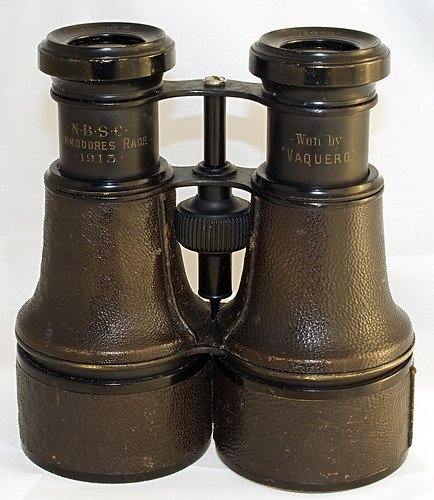
Because of the bank holiday I had to do my Friday trawl of Norwich's Junk Shop today. This was my outstanding find of the day. A pair of Binoculars inscribed N.B.S.C. Commodores Race 1913. Won by "Vaquero". This would have been before the Norfolk Broads Sailing Club moved into their present site in the 1930s on Wroxham Broad.
This is a double piece of local history because attached to the case are two tickets for entrance to the West Norfolk Hunt Club Grand Stand and Paddock. One for 1950 and one for 1955. This was presumably Fakenham Races. Interestingly the ticket in 1950 was 30/- (£1.50) - a very high price for the time and in 1955 it was 25/- (£1.25). The only example of deflation I can think of in 1950s Britain.
The only makers name on the binoculars is Chadburns Liverpool. It is unlikely they actualy made them but rather badgemarked them. Chadburns was and is famous as the manufacturers and inventors of ships telegraphs.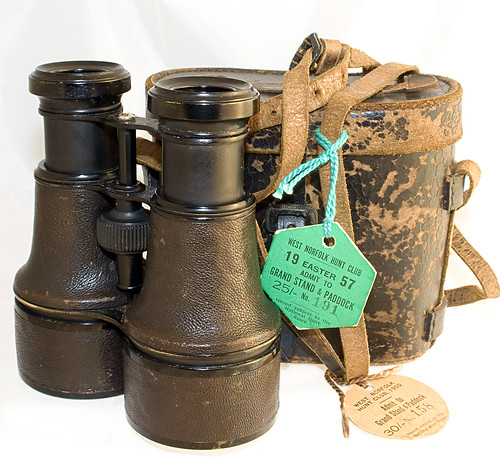
Thursday, April 21, 2011
A pair of Norfolk Broads Binoculars


Thursday, February 17, 2011
Deliverance - Thorpe Hamlet Style
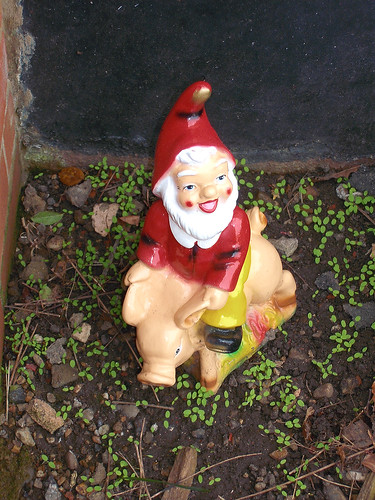
"Hey boy, you look just like a hog.... Come on piggy, give me a ride...Looks like we got us a sow here, instead of a boar....I bet you can squeal. I bet you can squeal like a pig."
Seen in a garden, St Leonards Road, Norwich.
Archaeology of domestic plumbing
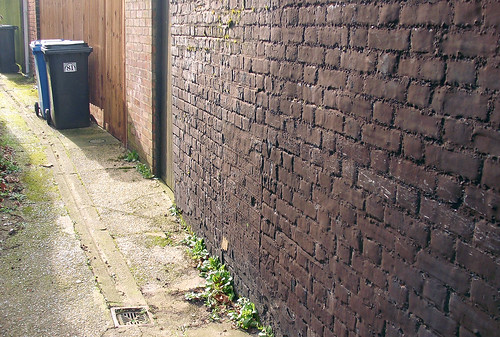
A change in the pattern in the bricks in the black painted wall reveals the position of the hatch from which "the Lavender Boys" would collect the night soil in the days before mains plumbing. Night soil was still being collected from some Norwich homes up until the 1960s.
The last Norwich Council houses to have outside (plumbed in) toilets were converted or pulled down in the mid 1970s. There are still Norwich City Council homes without baths (but with showers). The most famous recent example of bath-less council homes were the old people's sheltered housing at Greyhound Opening which were knocked down last year. Presumably someone at City Hall decided that Old People ought to be allowed to have baths.
Tuesday, January 18, 2011
The Joy of looking things up

I found this while hunting for stock in Norwich last week. It is a Kuhn Flexameter; which to the uninitiated was a waist level viewfinder designed in the 1930s to be clipped on to a 35mm camera and in particular to Leica cameras.
I was intrigued by the fact that it was made in Wetzlar, Germany which is the same town (city) that Leitz manufactured Leica cameras and decided to do some research.
The first thing I discovered was that it was designed by Frau Doktor Elsie Kuhn-Leitz. She was the daughter of Ernest Leitz II, President of Leitz and co-father of the Leica with Oskar Barnack who actually designed the camera. Kuhn was her married name.
I dug a little deeper and found out that Elsie Kuhn-Leitz should be better known as a courageous campaigner against the Nazis' treatment of Jewish and other forced labourers; she was imprisoned and tortured in 1943 by the Gestapo for helping two Jewish women in their attempt to escape to Switzerland. Her war time activities have been recorded in the book "Elsie's War, A Story of Courage in Nazi Germany" by Rabbi Frank Dabba Smith, Introduction by Henri Cartier-Bresson (Frances Lincoln Ltd,) 2003, ISBN 0-7112-1861-7. Her story is also touched upon in another book by the same author entitled "The Greatest Invention Of The Leitz Family: The Leica Freedom Train".
All of which knowledge, adds not a penny of monetary value to the Flexameter which if I am honest is clumsy to use and rather redundant and only of interest to Leica completists. Neither is it worth a lot of money in the first place. (I have to put that in to appease all the people who will find this posting after googling Kuhn Flexameter in an attempt to discover out what the one they found in Uncle Ernie's bottom draw is worth)
There is a sub-group of Leica camera collectors who specialise in collecting the so called blood Leicas; the ones built with the help of (mainly Ukrainian I think) slave labour. They drool over cameras engraved with Swastikas or bear the markings of the German Army, Air Force, SS etc. It is more than nice to find a Leica antidote to that kind of poison.
Oh and I have sold it anyway but the very few quid (really) I got for it is as nothing compared to the fun I had researching it or the sense of awe at the bravery of people like Elsie Kuhn-Leitz.
Tuesday, December 21, 2010
Digeridoo Seller
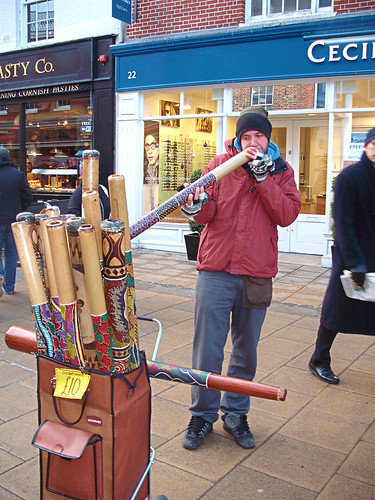
Happily demonstrating circular breathing. "Oh you can pick up the technique in about an hour" he said blithely.
I filed the statement away in the same compartment that I keep "Learn guitar in a day, the Bert Weedon Way" and "After only one lesson you will dance like Astaire"
The only such music slogan I ever believed was the one for the London Pianola Company that read "My daughter has a great foot for music"
Tuesday, November 30, 2010
Carte de visite, Norwich Castle

Albumen print by William Russell Sedgfield of Norwich Castle.
Marked on the back Sedgfield's English Scenery published by A. W. Bennet 5, Bishopgate Street Without, London E.C.
Sedgfield produced more than a thousand stereo photographs of English Scenery between 1855 and 1866 which were all published by Bennet. A lot of these were produced as single images to cash in on the craze for carte de visites.
Distressed does not begin to describe the condition of this photograph and only a sentimental nature and a love of stove piper hats have prevented it being consigned to the bin. Best viewed large.
Albumen print. Image size 2⅛ × 3½ inches mounted on card. Carte de visite.
Tasburgh Bell Hanging 1900

This is a scan of one of two photographs taken to celebrate the rehanging of the church bells at Tasburgh Church, Norfolk in 1900. The mount of this one is marked Alf. Robinson, The Studio, Long Stratton and I have no reason to believe that the second one is not by the same photographer.
The photograph shows a clergyman and two other gentlemen standing in front of 5 church bells outside Tasburgh church. The centre bell (the tenor?) is marked
RECAST 1900Records reveal that the rector of Tasburgh in 1900 was Walter Robert Hurd and a careful examination of the left hand bell in the back row reveals that the name of the second churchwarden was William Last Duffield (a surname still known in Tasburgh.) I am unable to make out the name of the first Churchwarden. Any help would be much appreciated in identifying him.
?. B. F.
W. L. D. CHURCHWARDENS
W. R. H. RECTOR
I used to think this was a photograph of the Rector, flanked by his two Churchwardens in front of his bells. I have now decided this is not the case. The chap on the left is too obviously an artisan. I think the bloke in the hat is probably a representative of the Bell Foundry.
In 1900 the bells of Tasburgh church were retuned and rehung. They were the first in Norfolk to be retuned on the 5 tone principle.* The company responsible were J Taylor & Co of Loughborough who are still in existence.

I think this second photograph probably shows the workman from J Taylor & Co. preparing to rehang the bells. The chap in the centre of the photograph is someone who features in the first photograph.
Both images are "Real Photographs" mounted on card. Photograph size 6in X 4in
------
* I did not know what the five tone principle is either. This from Taylor's website may explain (or may not.)
Taylor Five Tone Principle
Taylor's introduced their five tone principle of bell tuning in 1896. This produces the purity and sweetness of tone and allows the bell to sound with full and rich mellowness. This gives Taylor bells their special characteristic and sets them apart from all other cast bronze bells. The Bell Master and the Bell Tuner work on five principle harmonics, the hum, fundamental, tierce, quint and nominal but these in turn influence and affect many others. When the correct frequency for each of these harmonics has been achieved, the bell is in tune with itself. In a set of bells, each bell is tuned using the same standards applied to its own frequencies and thus each bell in the set is not only in tune with itself, but also with each bell in the set.
